Her mother named her Rita, after a woman she’d read about in the newspaper.
Rita Something; a stranger without a face, murdered in Florida the day before she was born. This fact stopped bothering Rita sometime in high-school- once she realized that most of us tie our identities to the legacies of dead strangers. Grandparents. Disciples. Poets. We are, all of us, faceless names etched over nameless faces. And in Pineview, Pennsylvania, people are nothing if not temporary. This is due, in a large part, to The Festival- a celebration of life in its most morbid form.
The streets were empty on the morning Rita Wheeler drove into town. Still, save a handful of streamers whipping against the dreary morning breeze. The sun, lost somewhere behind the smoke-stacks and horizon, painting the sky in strange shades. Blue. Purple. Cars, adorned with yellow traffic tickets grabbing for the wind, resting against the grit of the curb. A homeless man rises from a wooden park bench, stretching his back against the wrought-iron. Rita watches all of this from the driver’s seat of a cramped coupe, her passenger-side a collection of empty cans. Syringes.
The banner in front of the courthouse shifts against the clouds, inviting the second day of the annual festival to the destruction of the first. The liberation. Death. A man walks by, pushing a street-sweeper along the sidewalk; the hollow clicking of the motor like a hive of angry hornets. A hand-rolled cigarette juts from his crusted lips, the paper stained yellow with saliva. Tarnished. The cigarette falls and lands in an eruption of orange and red on the sidewalk; scarring the clean slate so nearly left behind. A gust of wind blows the stub through the rusted grate of a sewer-drain. The man keeps walking.
Styrofoam cups.
Cellophane wrappers.
Brain matter.
All sucked into that angry hive.
When all of this started, when Rita was in high-school, The Festival was supposed to be a positive thing. It was intended to bring closure. To bring the town together. To embrace the hundreds of neighbors who, in a moment of total despair, let their feelings be known only through the lonely report of borrowed pistols. Morphine tablets. Blood-stained sidewalks. But most notably, The Festival was supposed to be a response to the intersection of Church and East Main; the killing field where half of Rita’s graduating class chose to make their final stand. It all started with Thomas Deal and his black 1987 Camaro.
Back then, before The Festival, Rita would sit in the passenger seat- the cab rich with marijuana and gasoline. Midnight runs to nowhere, racing the headlights across backroads- her stomach sinking each time the pavement disappeared at the crest of a hill. His hand would move from the rusted knob of the shifter to the goose-bumped flesh of her inner thigh, his eyes more lost in hers than the future. The chassis vibrated, the engine pleading with them to slow down. To grow up. To give up, in a way- and be responsible. And so, it didn’t come as a big surprise to anyone in town when Thomas Deal’s Camaro clipped the side of a semi-truck and ended as warped steel against a light pole. Blood seeping through the too-hot floorboards, his broken body disguised behind splintered glass as the dying engine clicked and cooled. No skid marks. She couldn’t bring herself to go to the funeral.
After his, there was another. And another.
Travis Master, whose motorcycle dragged half of his sixteen-year-old corpse through the gravel parking lot of Bud’s Tobacco. Samantha Aldridge, decapitated in her mother’s convertible in front of Express Espresso as a crowd of onlookers sucked caffeine and ice through plastic straws. Soon enough, they lost their names. They became pictures in the local newspaper- weekend celebrities neither applauded nor cried for. That summer, the town elected Sheriff Jacob Fritz- who could be seen on the front-page wiping sweat from his brow, the bony knuckles of his opposite hand wrapped around the handle of a plastic grocery bag; the ghostly silhouette of Howard Coleman’s severed foot weighing them both down.
The headline- A Shoe-In.
And another.
And another.
The sun rose misty behind a smoke-stack. Police officers direct traffic, blowing whistles at school buses full of band-students, who press their sticky faces against streaked glass. The scent of funnel cake. Gunpowder. Food trucks, full of popping grease and salt, lined up around the courthouse- readying themselves for the crowd. News vans with long, twisting antennas; reporters with too much make-up and too little sleep. Rita parked her car in a garage a few blocks away, the backseat a mixture of filthy clothing. She hadn’t bothered to lock the door.
A woman walks by, dragging a child behind her on a leash- pulling him away from anthills and bullet casings. Baby strollers loaded down with disposable cameras and bottled water. Tired parents study Rita’s frail frame, her track-marks and scars a suicide note etched in Braille. A warning. The father pulls the baby from the stroller, burping it against his chest. The mother casts a wayward eye. The small family disappears around the corner, lost to the blast of an out-of-tune trumpet. The hesitant beat of a teenager with a bass drum.
It was Tuesday- the Day of Dead Dreamers. People who had grown up to believe that they could be writers, painters, musicians. Architects. Accountants who dreamed of Marine Biology. Second-hand BMWs. Desk-drawers over-stuffed with excuses. 401k’s. Tuesday was a day for people who were already dead, a fact only recently realized.
As a child, Rita was told that she could grow up to be whatever she wanted. What her mother meant, of course, was that she could try. The problem for both of them was that no one ever did. Their relationship had been defined by the promise of another chance, sometime in the distant future. That second chance had never come. Funny, how she held so tightly to that version of her mother- having forgotten nearly everything else. Anymore, Rita’s memories were just stories that she had told herself to keep from remembering; most of them short films built around fading photographs. A sentence. A smile. Each a pin-prick of light through the darkness of the needle; cardboard characters in a story so nearly lost.
Her shrunken shadow pressed against the cheap, plastic siding of the house. The red-and-blue of police lights. Over-cooked hamburgers. Acrylic nails, wrapped around the edges of a tampon box. Vodka. Cranberry juice. Chains clinking against the metal frame of a swing-set, settled in a nest of wood chips and daylight. These were the things that Rita talked about in meetings- details only understood in circles of smoke and coffee. The eyes of junkies moving across her body, their fingers nervously pulling at the rims of Styrofoam cups; rattling baggies of brown powder and motioning to the dumpster in the corner of the parking lot. None of them looked like Thomas Deal. None of them talked to her so sweetly.
Rita turned the corner, the town square opening up before her. A sea of sun-visors and spray-fans; tank-tops and pink skin. Two men, college age, lift the body of a dead man from the sidewalk, their lips filled with chewing tobacco. Their hats spun backward. They laugh to each-other, resting the limp corpse in a borrowed wheel-barrow. The tire is flat. The body shifts against the rusted bucket. Hair and flesh dangle from the hollow cavity of his skull. One vacant eye studies the crowd, lolling from side to side as the larger of the two men pushes the wheelbarrow over a large rock. Rita is the only one that seems to notice. Everyone else is looking up, saluting the sun.
A couple, their faces lost to the brilliant yellow rays, stands over the crowd. The woman, the trail of her wedding dress teasing the ledge, lets go of the man’s hand to wipe her own against the flowing fabric. The man’s bowtie tilts against the wind. A high-school band plays a fight-song. The crowd chants. The two step up on the ledge. The woman next to Rita wraps a finger around a sugary cloud of cotton-candy. They lean forward, and land in a broken, bloody pool at the feet of strangers. A child scrapes his shoe against the pavement, trying to wipe away a sticky film of fountain soda and popcorn kernels. They convulse, pulling away from one another. People throw rice over the bodies.
The wheelbarrow arrives. White-and-red lace edging up cold, pale flesh. They leave the man on the ground- there isn’t enough room for both of them. Rita reaches into her worn, leather handbag and wraps her fingers around an orange capsule. Bile bites the back of her throat as she runs one chipped fingernail along the serration of the lid. She swallows, forcing it back into the empty pit, and pulls her hand out of the bag. Her vision twists, her breath comes in startled gasps. She backs out of the crowd, steadying herself against the plate-glass window of an ice cream shop with one hand. On the other side, a toddler looks up from a half-melted bowl; sticky vanilla dripping from her chin to a puddle on the table.
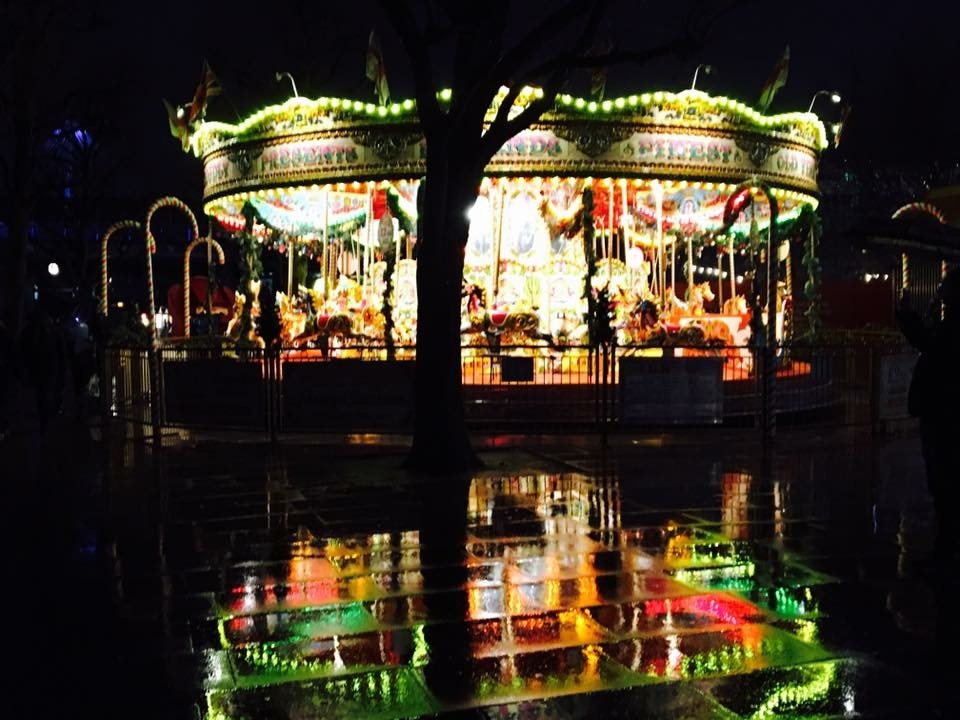
Rita lowers herself to the sidewalk, the pavement hot against her skin. Soothing. She opens the clasp on the handbag and places it between her legs, watching the sun play through the pill capsule; the rays lost to the chalk-dust residue. Behind her, the toddler bangs the edge of her spoon against the glass. Rita doesn’t look up. A group of teenage boys step over her, laughing. A gunshot. The men with the wheelbarrow walk past, their shirts lined with sweat; their chins stained with tobacco. Soda turns to beer. The click and buzz of neon lights. The sky morphing to a hollow gray. Red stains turn black, their edges lined with bending streaks of blue and green.
Rita shuffles the pills into a small avalanche in the palm of her hand, thinking of her mother. As a child, Rita would gag against the noxious orange syrup coating her throat as her mother rapped her nails against the open bathroom door. As an adult, she rarely flinched as the needle pushed into the vein; filling her with a warm, distant feeling. The clamor of a handful of family-friends in the next room, voices chasing one another in faux affection and pointless stories.
They found Rita in the guest bathroom, a thin film of yellow and white dripping from her lips. Her eyes rolled back. A Christmas dinner painted red-and-blue. Ornaments shattered by a paramedic’s gurney. A meal growing stale behind an empty chair. That same look of impatient disappointment.
Her mother died on a Friday. The Fridays of The Festival were dedicated to divorcees who thought that they could restart their lives in their fifties with the same fervor of twenty-five, as though everything was still ahead of them. As though their sides didn’t hurt from decades of abusing the bottle. Themselves. On Fridays, most of the festivities take place in the dark. There is a hollow community to Fridays, the teasing of a second chance in the arms of each passing stranger.
Rita pours the chalky pills into her mouth, biting down against the bitter edges of the painkillers. She swallows them dry- a thousand razor blades lodged in her throat. A man walks by and offers a cigarette. She waves him off and rests her head against the brick wall, watching the colors blend and shift. She thinks of over-cooked hamburgers. Swing-sets. Promise, and its elusive nature.
Her mind floats to Thomas Deal and a black Camaro that wouldn’t slow down. Couldn’t slow down. The need to be gone in an instant. In a flash. In a rage of twisted metal and heated spoons and broken Christmas ornaments. She thinks of wheelbarrows and candy; lollipops laced with heroin, dancing to a childhood song.
As she falls asleep, Rita Wheeler thinks of a woman in Florida- murdered for her namesake.
 The Nightmare Box
Leave a comment